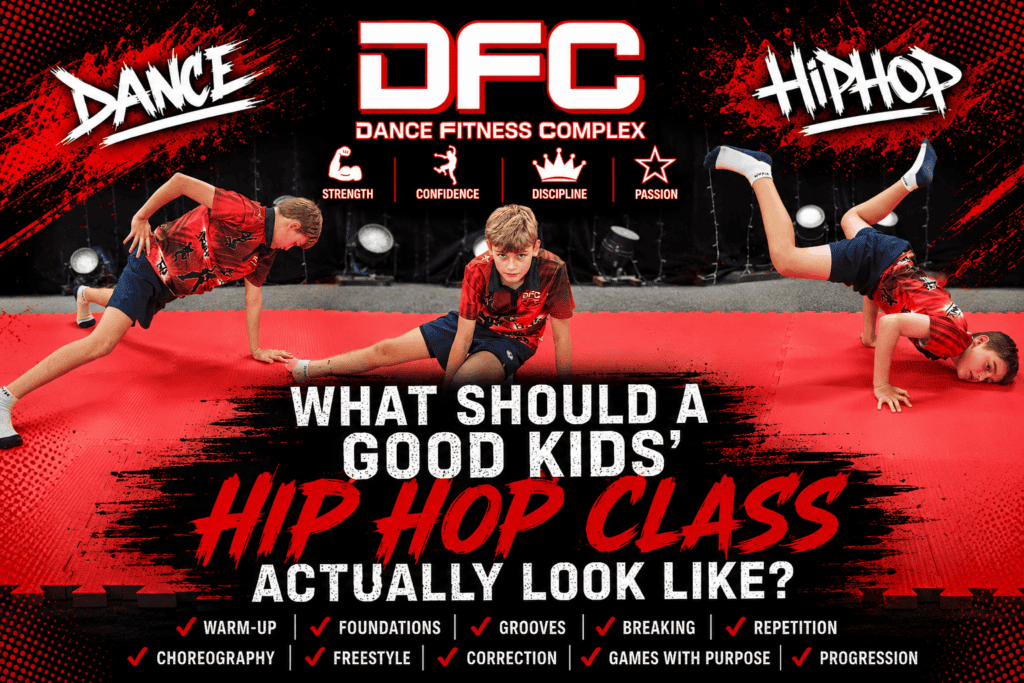
What Should a Good Kids’ Hip Hop Class Actually Look Like?
If you’re looking for kids’ Hip Hop classes in Townsville, how do you know whether your child is receiving quality Hip Hop training — or simply learning a new routine each week?
It’s an important question.
To someone watching from outside the studio, a good Hip Hop class can look like a room full of children moving to music, learning choreography and having fun.
But as a dance teacher with more than 30 years of teaching experience, I’m looking for much more.
I’m looking at how children are being taught to move.
Are they developing rhythm and musicality?
Do they understand the foundations behind the movement?
Are they learning to control their bodies?
Are they being corrected?
Are they given opportunities to practise?
Are they developing confidence to move without simply copying the teacher?
Are they learning what to do when something doesn’t come easily?
And importantly — are they progressing?
A quality kids’ Hip Hop class should absolutely be enjoyable. Children should laugh, connect with their classmates and leave looking forward to coming back.
But enjoyment and learning are not opposites.
A great class provides both.
Here’s what I believe parents should expect from quality Hip Hop classes for kids — and what we work towards every week at Dance Fitness Complex in Kirwan, Townsville.
1. A Good Hip Hop Class Starts With a Purposeful Warm-Up
A warm-up isn’t something a teacher does simply to fill the first five or ten minutes of class.
It prepares the dancer for what is coming next.
Depending on the students’ ages and what we are working on that day, a warm-up might include:
- Cardio and whole-body movement
- Joint mobilisation
- Isolation exercises
- Coordination activities
- Dynamic stretching
- Rhythm and groove exercises
- Strength and body-control activities
For younger dancers, the delivery needs to be engaging and age-appropriate.
For older students, warm-ups can become increasingly technical and physically challenging.
But there should always be a reason behind what we’re doing.
If students will be working on Breaking later in class, for example, I want their wrists, shoulders, core and lower body appropriately prepared for floor-based movement.
A good warm-up isn’t separate from the lesson.
It is the beginning of the lesson.
2. Hip Hop Foundations Should Come Before Fancy Choreography
This is one of the biggest things I want parents to understand about quality Hip Hop training.
Learning choreography does not automatically mean a child is learning how to dance Hip Hop.
A dancer can become very good at remembering a sequence of movements without understanding the foundations underneath those movements.
That’s why foundations matter.
At DFC, students work on areas such as:
- Bounce
- Rock
- Grooves
- Rhythm
- Timing
- Footwork
- Body isolations
- Weight transfer
- Musicality
These skills might not always look as impressive on social media as a finished routine.
But they are incredibly important.
Think about learning a language.
You wouldn’t expect a child to memorise paragraphs without first developing vocabulary and understanding how sentences work.
Dance is similar.
Choreography gives dancers something to perform. Foundations give dancers the ability to actually dance.
3. Grooves Matter More Than Many Parents Realise
Groove is one of the things that gives Hip Hop movement its feeling.
Two dancers can perform exactly the same choreography and look completely different.
Why?
Often, one is simply reproducing the steps while the other is actually dancing within the music.
Children need opportunities to develop that relationship between their body and the beat.
That means repeating movements.
Feeling different rhythms.
Changing levels.
Experimenting with energy.
Learning when movement should feel relaxed, grounded, sharp, heavy or controlled.
This doesn’t happen overnight.
And it certainly doesn’t happen by constantly rushing onto the next piece of choreography.
A strong Hip Hop program gives dancers time to live inside the movement, rather than simply memorise it.
4. Breaking Should Be Taught as a Skill — Not Just a Cool Trick
Breaking is one of my favourite areas to teach because it develops so much more than something impressive for a dancer to show their friends.
Age-appropriate Breaking training can develop:
- Strength
- Coordination
- Balance
- Body awareness
- Weight transfer
- Floorwork
- Control
- Agility
- Persistence
Students might work on foundations and skills such as Kick Outs, Six Steps, Coffee Grinders, freezes and different ways of transitioning between standing and floor-based movement.
But there’s an important distinction.
Breaking shouldn’t simply become “let’s see who can do the coolest trick.”
Students need progressions.
They need to understand where their weight goes.
They need strength and control.
They need opportunities to repeat movements.
And they need to learn that not mastering something immediately is completely normal.
Breaking can be challenging.
That’s one of its greatest Benefits.
A student might attempt something, struggle, listen to a correction, change their position and try again.
Eventually something clicks.
That moment isn’t just:
“I learnt a Breaking move.”
It’s:
“I couldn’t do this before — and now I can.”
That’s powerful.
5. Repetition Is Not Boring — It’s How Dancers Improve
Children often want to move onto the next exciting thing.
Sometimes parents do too.
But good teaching isn’t about constantly presenting something new.
Progress requires repetition.
A student needs opportunities to repeat a groove until it becomes natural.
Repeat footwork until their body understands the pathway.
Repeat a Breaking skill until they develop greater control.
Repeat choreography until they stop thinking about what comes next and can start thinking about how they’re performing it.
The teacher’s job is to make repetition productive.
We might change the music.
Change direction.
Increase the speed.
Work individually.
Work in groups.
Turn something into a challenge.
But underneath all of that is repetition.
There is an enormous difference between doing something once and owning the skill.
6. Choreography Still Matters — But It Should Have a Purpose
Choreography is absolutely part of Hip Hop training.
It develops:
- Memory
- Timing
- Musicality
- Coordination
- Performance quality
- Spatial awareness
- Confidence
- The ability to learn and retain movement
But choreography shouldn’t be the entire curriculum.
A good teacher uses choreography to bring different skills together.
Students might have been working on grooves, footwork, isolations and musicality separately, then encounter those same concepts inside a routine.
That’s when choreography becomes more than:
“Copy me.”
It becomes an opportunity to apply what the dancer has been learning.
As students progress, I also want them thinking beyond remembering the sequence.
Where should the movement hit?
What is happening in the music?
What energy does this section require?
Where are your eyes?
How are you using your body?
Are you performing — or simply remembering?
Those questions are part of developing a dancer.
7. Children Need Opportunities to Freestyle
Freestyle can feel intimidating at first.
That’s okay.
A child who has always been told exactly what movement comes next may initially freeze when suddenly told:
“Now you choose.”
But that’s exactly why freestyle is valuable.
Hip Hop should give dancers opportunities to develop their own movement and personality.
At DFC, I don’t want 20 children who can only dance when someone is standing in front of them showing them what to do.
I want students to gradually develop the confidence to listen to music and make their own choices.
Freestyle develops:
- Creativity
- Musicality
- Confidence
- Decision-making
- Individuality
- Movement vocabulary
This is also where one of the things I love most about Hip Hop becomes visible.
You can learn a style without losing your own style.
Two children can learn the same foundations and express them differently.
That’s not something I want to remove.
It’s something I want to develop.
8. Good Teachers Give Corrections
This is important.
A supportive dance class does not mean a class where children are constantly told everything they’re doing is perfect.
If I correct a student, it’s because I believe they’re capable of improving.
A correction might be:
“Bend your knees more.”
“Watch where you’re placing your hand.”
“Listen for that beat.”
“Try it again.”
“Slow it down.”
“Use your whole body.”
Corrections need to be age-appropriate, constructive and delivered in a way the child can understand.
But they are necessary.
Children also need to learn that receiving a correction isn’t criticism of who they are.
It is information.
Good dancers learn how to receive feedback, apply it and try again.
That’s a skill that reaches far beyond the dance studio.
9. Yes, There Can Be Games — But They Should Have a Purpose
Especially with younger children, play can be an incredibly useful teaching tool.
At DFC, you might see musical statues, dance battles or movement challenges.
The kids might simply think:
“This is fun!”
As the teacher, I’m seeing something else.
Musical statues can develop:
- Listening
- Musical awareness
- Balance
- Strong poses
- Body control
Dance battles can develop:
- Confidence
- Freestyle
- Creativity
- Musicality
- Performance
- Supporting other dancers
Challenges can encourage repetition without making it feel repetitive.
That’s what I mean when I talk about fun with purpose.
Children should enjoy their class.
But a quality dance program doesn’t need to choose between fun and learning.
The best teaching often combines them.
10. Students Should Be Expected to Focus
A good kids’ Hip Hop class should be supportive.
But supportive doesn’t mean there are no expectations.
Students need to learn how to:
- Look when something is being demonstrated
- Listen to instructions
- Think about what they’re being asked to do
- Prepare their body to learn
- Communicate appropriately
At DFC, these are part of our 5 Focus Skills: Looking, Listening, Thinking, Body Posture and Voice.
Focus isn’t something I expect every four-year-old to arrive already possessing.
It’s something we develop.
Just like coordination.
Just like rhythm.
Just like confidence.
Children learn that there are times to laugh and have fun — and there are times when everybody needs to stop, listen and learn.
Both can exist in the same class.
11. Progression Should Be Visible Over Time
Perhaps the biggest sign of a quality Hip Hop program is this:
What happens next?
If your child attends for six months, are they simply learning six months’ worth of unrelated routines?
Or are the skills building on one another?
Good dance training should have progression.
A beginner might start with basic rhythm, coordination, grooves and simple Breaking foundations.
As those skills develop, the student can tackle more complex footwork, musicality, choreography, freestyle, Breaking and performance.
Progress will not look identical for every child.
One child may develop physical skills quickly but take longer to freestyle confidently.
Another may have fantastic musicality but need more time developing strength.
Another child’s biggest achievement may initially be participating without constantly checking whether Mum or Dad is watching.
Progress isn’t always a bigger trick.
Sometimes it’s better focus.
Greater independence.
More confidence.
Cleaner technique.
Stronger musicality.
The willingness to try.
Good teachers notice those things too.
What Should Parents Look For in a Kids’ Hip Hop Class?
When comparing kids’ Hip Hop classes in Townsville, don’t only ask:
“Did my child have fun?”
Of course enjoyment matters.
But also ask:
Did they learn something?
Were they actually taught?
Did the teacher notice them?
Were they challenged appropriately?
Did they receive feedback?
Are they learning foundations as well as choreography?
Is there a pathway for them to progress?
Are effort, focus and respect expected?
Can they develop their own style and creativity?
Those questions tell you far more about the quality of a dance program than how flashy the final routine looks.
What a DFC Hip Hop Class Is Designed to Deliver
At Dance Fitness Complex in Kirwan, Townsville, the goal isn’t to simply keep children busy for 30 or 40 minutes.
Every class is designed around the DFC Method™, developing the whole dancer through Belonging, Focus, Confidence, Courage, Character, Movement, Skill and Performance.
That means your child will have moments where they laugh.
Moments where they’re challenged.
Moments where they’re corrected.
Moments where they struggle.
Moments where they succeed.
And hopefully plenty of moments where they surprise themselves.
Because quality Hip Hop training isn’t about making everything easy.
It’s about giving children the instruction, environment and encouragement they need to discover:
“I can learn difficult things.”
And that may be one of the greatest Benefits dance can give them.
Looking for Kids’ Hip Hop Classes in Townsville?
If you’re looking for Hip Hop classes for kids in Townsville, DFC offers structured Hip Hop and Breaking training for children and teens in Kirwan.
Beginners are welcome, and your child doesn’t need to arrive already knowing how to dance.
They simply need to be ready to listen, learn and give it a go.
The Simple and Easy first step is a $19.99 Hip Hop Trial Class where your child can experience the DFC environment, meet their teacher and discover what a real class feels like.
Dance Fitness Complex
Kirwan, Townsville
Hip Hop & Breaking | Ages 4–14
Ready to see what your child is capable of?
Book their $19.99 Hip Hop Trial at www.dancefitnesscomplex.com.au